NLP (Natural Language Processing) engineering is currently witnessing a structural mutation in web referencing. After two decades dominated by string matching, the ecosystem is shifting toward vector inference logic driven by AI SEO.
This is not just an algorithmic update, but a topological change.
To optimize content for ChatGPT, Claude, or Google SGE (Search Generative Experience), it's imperative to abandon the "librarian" vision (indexing) for that of the "neural network" (understanding). Here's a technical dissection of the fundamental differences between Traditional SEO and LLM SEO (also called GEO - Generative Engine Optimization).
1. Reading Mechanism: From HTML Parsing to Vector Embedding
The major distinction lies in the protocol for reading and assimilating content by the machine.
Traditional SEO: The Crawler and Inverted Index
The historical functioning of search engines (like Googlebot) relies on HTML parsing and lexical analysis. The process involves downloading the DOM, text extraction, stop-word cleaning, and storing lemmas in a massive inverted index.
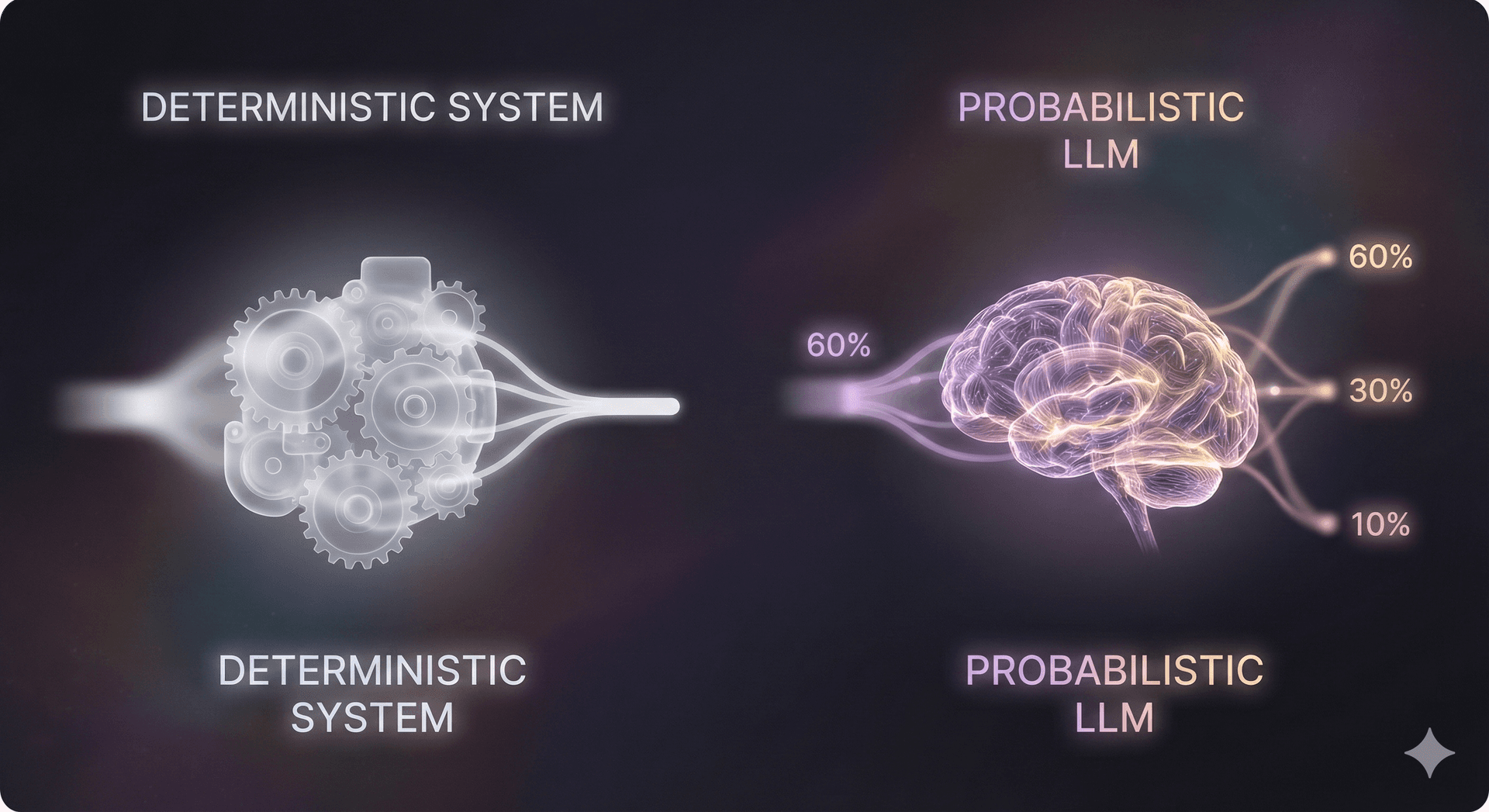
If a page contains the token "running shoe" in an <H1> tag, it's mapped to that specific query. The system is deterministic. Although semantics are simulated (via knowledge graphs), the atomic unit remains the keyword (see our article on E-commerce GEO).
Indexation Classique
RAG Pipeline
LLM SEO: Tokenization and Latent Space
Conversely, an LLM (Large Language Model) doesn't "read" in the literal sense. It proceeds by tokenization (via algorithms like Byte-Pair Encoding - BPE), then converts these tokens into Vector Embeddings.
In the LLM SEO paradigm, content is no longer a list of words, but a numeric vector (e.g., [0.12, -0.45, 0.88...]) positioned in a multidimensional space.
AI doesn't search for an exact keyword match. It calculates the Cosine Distance between the user query vector (the prompt) and the vectors of indexed content.
Vector Space Visualization (t-SNE)
Technical Implication: Keyword stuffing becomes obsolete, even counterproductive. Repeating "Tax Attorney" increases the vector magnitude without changing its semantic direction, risking a penalty for low informational entropy. AI "understands" the global concept, regardless of exact syntax.
2. Ranking Factors: From PageRank to Attention Weights
The criteria determining source citation or content generation are evolving radically.
Traditional SEO: Link Graph (Backlinks)
Historically, authority is calculated via a graph structure where nodes are pages and edges are links. The PageRank algorithm evaluates authority by node centrality in this network. It's an external peer validation system.
LLM SEO: Co-occurrence and RAG (Retrieval-Augmented Generation)
In the context of LLM SEO, authority becomes multidimensional and operates in two phases:
- Training Phase (Pre-training/Fine-tuning): The model learns probabilistic associations. If the term "Best CRM" appears statistically often near "Salesforce" in the training corpus, the synaptic weight between these entities strengthens. This is called semantic co-occurrence.
- Inference Phase (RAG): For web-connected engines (Perplexity, Bing Chat), AI performs real-time search, retrieves text segments (chunks), and injects them into its "context window".
The dominant ranking factor becomes Information Density. The attention algorithm (core of Transformer architectures) assigns a higher "attention score" to passages containing the densest and most factual answer, to the detriment of diluted content.
Poids des Facteurs de Ranking
3. Content Format: From Length to Density
The 2010s SEO standard, "Skyscraper Content" (very long articles covering the entire semantic field), is being challenged.
Traditional SEO: Long-form
The goal is to maximize time spent on the page (Dwell Time) and multiply long-tail keyword occurrences to capture broad traffic.
LLM SEO: Structured and Dense
For an LLM, verbosity constitutes noise.
- Computational cost: Context windows have a size limit and processing cost.
- Vector dilution: Excess non-informative text dilutes the precision of the key passage's semantic vector.
Format de Contenu
AI SEO optimization requires formatting that facilitates extraction (Information Extraction):
- Intensive use of bullet lists and Markdown tables.
- Implementation of JSON-LD to provide unambiguous "Ground Truth".
- Encyclopedic style favoring structure: Subject + Verb + Factual predicate.
4. The "Black Box": Determinism vs Probabilities
This is where the technical break is most sensitive for domain experts.
Traditional SEO: Obscure but Fixed Rules
Although Google's exact algorithm remains secret, it operates on logical rules. Respecting technical, semantic, and popularity criteria mechanically guarantees progression. The system is stable.
LLM SEO: The Stochastic Nature
LLMs are by nature probabilistic and non-deterministic. To an identical question ("Who is the market leader?"), a model may vary its answer according to its "Temperature" (creative variability parameter) or immediate context.
Moreover, opacity is total.
Architecture Comparison: Legacy vs AI Stack
Classic Indexing
Retrieval Augmented Gen.
The shift from deterministic indexing to probabilistic inference.
Loss of control between direct indexing and generative synthesis.
As this diagram illustrates, in LLM SEO, content passes through a neural abstraction layer capable of hallucinating, reinterpreting, or ignoring data based on its training biases, even when faced with technically optimized content.
Conclusion: Toward Answer Engineering
The transition from SEO to LLM SEO signals the end of optimization for search engines and the advent of optimization for answer engines.
For engineers and marketers, the goal should no longer be just to "rank a URL", but to insert immutable and structured facts into the model's knowledge graph. This requires a transition from literary writing to data structuring and managing your semantic e-reputation.
The future of technical SEO no longer lies in the keyword, but in mastering the vector.